While this post isn't exactly transit related, broader planning practices on major North American infrastructure projects provide valuable context. LaGuardia Airport is the dominant short haul airport in the New York area. Its existing Central Terminal Building was completed in 1964 and is both dilapidated and severely overcrowded. After many years of discussion, the Port Authority of New York and New Jersey has decided to build the long-overdue replacement. The details are discussed in the project briefing book, but one element stands out as potentially problematic. The large majority of gates in the new terminal building are designed for Boeing 737/Airbus A320-sized narrowbody aircraft, which along with regional jets make up the overwhelming majority of short haul flights in North America.
In the 1970s, however, far larger aircraft were used on short-haul routes, and the widebody DC-10 was designed specifically to fit at LaGuardia. In order to permit airlines to operate some larger aircraft, planners chose to design a handful of gates for Aircraft Design Group IV, which includes the Boeing 757 and 767 aircraft that airlines might choose to operate. So far, so good. The problem is that no Group IV aircraft has been designed in decades. The Boeing 757 and 767 are no longer being produced for airlines and their replacements, such as the Boeing 787 and Airbus A330, have considerably longer wingspans, causing them to be categorized in Design Group V. By the time the LaGuardia Airport expansion is complete, there aren’t likely to be many Design Group IV aircraft operating, and those that are will be fast approaching retirement. These gates will be essentially useless the day they open, as the larger aircraft for which they were intended will not fit and smaller aircraft will be able to use the other Group III gates. While this problem will hopefully be caught by the time detailed plans are drawn, it is not a particularly auspicious sign for the success of the project, and is perhaps a sign of why so many large infrastructure projects require costly mid-construction re-designs.
Wednesday, December 11, 2013

Monday, December 31, 2012
The Weston Corridor Is Not Full
Every decade or so, a new study of
high-speed rail in the Quebec City-Windsor Corridor provides fascinating
reading for people interested in transportation and infrastructure. Of course,
such literature belongs firmly in the Fantasy section of the local library. The
most recent report, titled “Ecotrain”, was produced in 2010 to update a more
detailed 1995 study, making adjustments for changing circumstances and
development. The earlier report recommended following international best
practices by establishing seamless connections between high-speed rail and
major international airports, permitting the replacement of short-haul flights
with airline code-shares on trains. In order to access Pearson Airport from
Union Station, high-speed trains would share the Weston corridor with other
rail services. Unfortunately, the recent report indicates that informational
meetings with Metrolinx resulted in the determination that the Weston corridor will
be at capacity and would not be able to accommodate any high-speed services. (Deliverable
5, page 37)
This is particularly bizarre since
Metrolinx is in the process of adding a pair of tracks for express trains from
Union to Pearson Airport. At four trains per hour each way, it is quite
disturbing to think that the agency might consider those tracks to be at capacity. By contrast, 28 trains per hour or more is normal in Europe, Asia, or even many parts of North America. One of the
greatest assets of the airport shuttle project is the provision of two separate
pairs of tracks for express and local services in the Weston corridor.
Ultimately, one pair could be used for CityRail-style services while the other
would be shared by the airport shuttle, regional express trains, and high-speed
or intercity trains—essentially all trains skipping most stops between Union
and Pearson. Certainly the addition of a handful of electric high-speed trains
an hour would not be an undue burden on the neighbourhood. It would be an
enormous waste of resources if a valuable pair of express tracks were reserved
for the exclusive use of the airport shuttle when there is more than enough
capacity for all conceivable express and intercity services.
Sunday, October 14, 2012
The Interaction of Freight and Passenger Rail
Anyone who has ever ridden a train in
Europe (let alone Japan) has seen that they know how to run a railway. Their
passenger trains are faster, more reliable, more extensive, and far more
frequent than in North America. Unless one enjoys hopping freight cars,
however, it is less obvious but no less true that North America has many
lessons to teach Europe about freight rail. In fact, Canadian railways move
almost as many tonne-kilometres of freight per year as moves by rail in the
entire European Union – 349.1 billion tonne-kilometres
in Canada versus 377 billion in Europe.
Canadian freight railways benefit from long distances and shipments of bulk
natural resources, but the figure remains striking given the difference in
population and economic size.
In recent decades, North American railways
have become increasingly reliable and economical providers of freight
transportation service. They’ve expanded beyond their traditional dominance in
hauling bulk goods like coal and grain over long distances and have made major
gains in hauling manufactured goods since the invention of the intermodal
container. Canada’s own CN is often considered the gold standard of freight
railways worldwide. Meanwhile, in Europe, most bulk traffic uses the
continent’s extensive inland waterway network, while lighter goods tend to move
by truck.
Operating a successful freight railway
presents very different challenges from passenger rail. The most important
criteria of success for freight rail are cost, followed distantly by
reliability. As long as their goods arrive within a few hours of promised and the
bill is lower than if they had gone by truck, most shippers are quite pleased.
Low cost is achieved by packing as much as possible into each freight car, and
as many cars onto each train. Over the past several decades, North American
freight railways have invested billions into improving their infrastructure to
increase their competitiveness. Tracks have been upgraded to accommodate
heavier freight cars, new technologies like locomotives distributed throughout
the train have permitted longer trains, and bridges and tunnels have been
raised to permit the stacking of two shipping containers on each car. European
freight cars look like toys compared to their North American counterparts and
double-stacked containers are unheard-of. The average European train is less
than thirty cars long, while more than a hundred cars per train is the rule in
North America.
North American passenger rail operators are
often quite reasonably accused of trying to operate as if they were freight
railways, using freight locomotives, freight track maintenance standards and
freight signalling systems. Europeans make the same mistake in reverse, trying
to emulate their success in passenger rail by emphasizing the importance of
speed and punctuality, even going so far as to propose running freight trains
on high-speed lines. This does nothing to aid in the critical factor of cost
per ton-mile. The limited amount of existing freight rail traffic makes large
investment seem excessive, just as the low ridership of North America’s weak
passenger rail service is used to claim that passenger rail investment is uneconomic.
Of course demand is low when the service is poor; demand won’t get any higher
until the service is improved.
The poor state of European freight rail is
a clear demonstration of the difficulty of operating both a successful
passenger and freight railway. The needs of the two types of trains are simply too
different. In fact, much of what makes European passenger rail so successful
causes serious problems for freight. Heavy North American freight trains wreak
havoc on high-quality track built for high-speed passenger service. Europe’s
extensive track electrification offers enormous benefits, but it also limits
overhead clearance for double-stack containers. High platforms at stations
permit passengers to board without needing to climb stairs, speeding loading
and providing wheelchair accessibility. Unfortunately, they can also restrict
the width of passing freight trains. Some of the problems are simply the result
of history, particularly in Britain where railways were built in the Victorian
age to a very narrow loading gauge. New European lines are built to minimize
curves, a big problem for high-speed passenger trains, but which comes at the cost
of steeper grades that are a nightmare for heavy freight trains. European
railways have been built over decades for passenger rail, not freight, so it
isn’t surprising that European freight railways have struggled.
The needs of passenger and freight railways
are so different that separation is likely the only solution. Of course,
passenger trains and freight trains can still share tracks in many places, especially
on low-density long distance passenger routes, but major passenger corridors
should be separated from major freight routes so that they can be optimized for
their respective users. Fortunately, the advent of intermodal shipping means
that only a core of freight network is required; instead of picking up a few
cars at each shipper, much freight traffic is now delivered by trucks to a
relative handful of intermodal terminals. North America benefits from its
legacy of competing private railways, which produced multiple parallel
corridors that can now be divided between passengers and freight. The Amtrak-owned
Northeast Corridor has almost no freight traffic, as there is a parallel corridor
owned by the freight railways and dedicated to their trains. Europe needs to
embark on the arduous project of clearing a core network for heavy freight cars
and double-stacked intermodal containers, likely after shifting most passenger
trains to new high-speed lines.
Running a decent regional rail system in a
North American city will require the exclusion of most freight trains from
regional rail tracks. Local customers can have freight cars picked up and
dropped off at night, when regional trains are not operating, but through freight
traffic should use dedicated tracks. Especially for high-speed lines, the
problems posed by North American heavy freight on track superelevation, track wear,
platform height, and collision safety are too problematic for extensive track sharing.
(More in future posts on sharing between freight and CityRail) Fortunately, many cities including Toronto have already shifted most of their
freight rail traffic to bypass routes in the suburbs. Toronto’s main intermodal
terminals are in Brampton and Vaughan and there are relatively few directly
served industrial customers in the city centre. The Barrie and Stouffville lines,
and most of the Richmond Hill, Lakeshore and Kitchener lines, have very little
through freight traffic. The Milton line and segments of other routes would
simply require separate tracks for freight traffic, either in the same corridor
or on a new parallel route. Most freight traffic in the GTA would not interact
with CityRail at all, while separating the two track users where they do
interact would not be an insurmountable task.
Thursday, September 20, 2012
Eglinton-Crosstown LRT News
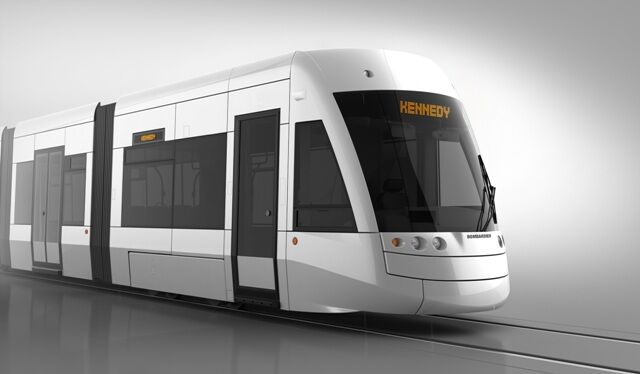 |
| The Eglinton-Crosstown LRT (Source: Metrolinx) |
This article is shared with Urban Toronto.
This morning, Metrolinx announced its decision to proceed with an alternative financing and procurement model for the new Eglinton Crosstown LRT. In other words, private consortia will compete for the right to build and operate the new line instead of the TTC. If the contract is well designed, this approach can transfer the risk of delays and cost overruns from the government to the private partner. The Canada Line in Vancouver is a good domestic example of this type of procurement, and its private consortium completed the project more-or-less on budget and in time for the 2010 Olympics.
The TTC’s response quoted in the Star verged on the bizarre, trying to cause anxiety that riders would be forced to pay separate fares to ride the new Eglinton line. This certainly need not be the case, as the Canada Line is fully integrated into the existing transit system with seamless connections. The TTC tried to claim that Eglinton Crosstown and the Canada Line are “a completely different scenario because the Canada Line is restricted to a single route with far fewer connections than the Eglinton line will have, and no zones.” It is difficult to understand what they meant by far fewer connections, since the Canada Line connects with the existing Skytrain and numerous bus routes. The presence of zone fares in Vancouver is also an irrelevant distraction. The TTC understandably isn’t enthusiastic about losing control of a major piece of transit infrastructure in the middle of its service area, but a well-designed AFP could prove to be a cost-effective option.
Eglinton Crosstown and the Canada Line are hardly “completely different” and there is absolutely no reason why Eglinton can’t and won’t be completely integrated into the TTC’s fare system. The main difference between the two lines is that the Canada Line cost $2 billion for 19.2 km of fully grade-separated rapid transit, while the Eglinton line is projected to cost three times as much (~$6 billion at last count) for 25 km (including rehabilitation of the existing Scarborough RT corridor) with far less capacity and a reliability-killing on-street section in the middle.
 |
| The Canada Line Bridge over the Fraser River (Source: Canada Line) |
With cost estimates already so high, there is little incentive for the private consortia to keep costs low. If the private bidders were to be able to reduce costs to even twice that of the Canada Line per kilometre, it would likely be possible to fully grade-separate the Eglinton Crosstown (perhaps with an elevated segment through western Scarborough) without increasing its current budget.
Transit-Oriented Development Failure: Brampton Edition
It is difficult to find a better example of
the failure to site major development around transit infrastructure than the
planned Osmington mall in Northwest Brampton. This vast project is intended to encompass
a regional mall of over 1 million square feet, 300,000 square feet of office
space, 2,000 residential units, and a 350-room hotel. 4,600 people will commute
there for work every day. It will be designed on “lifestyle centre” principles,
similar to the new Don Mills Centre, which are intended to create a suburban
experience that is more pedestrian-friendly than the traditional
mall in a sea of parking. Regional malls adjacent to TTC subway stations
generate thousands of transit riders per day. It’s hard to imagine anything
better suited to being located at a suburban transit hub.
Unfortunately, this immense new development
will be located just beyond reasonable walking distance of the Georgetown GO
corridor and the Mount Pleasant station. Instead, it will be built as suburban
malls have always been: at an arterial intersection next to the planned Brampton
North-South expressway, a bleak 1.2 km walk from the rail station. The planning
report pays lip service to “transit-oriented development,” but the Osmington
project will not be oriented to the rail corridor that should be the backbone
of transit in the region. Meanwhile, Mount Pleasant station will be surrounded
by quaint townhouses and strip mall retail that will generate at best a few
dozen riders a day. While townhouses may create the old-timey
village-around-a-station effect that feels like appropriate transit-oriented
development, a large shopping centre, even with a suburban design, generates
far more riders.
Of course the existing commuter-oriented,
peak-only GO rail service wouldn’t be terribly useful for a shopping
destination. But CityRail-style regional rail service would provide rapid
transit service and this development could be one of its major anchor
destinations.
Tuesday, August 28, 2012
CityRail In Depth: Corridor Capacity
Toronto is facing a transportation crisis. We have more people using every form of transportation than any of the systems were designed to accommodate. Our best chance to expand rapid transit throughout the GTA for the smallest price is to add a new level of train service, referred to here as CityRail. This is the second in a series of in depth articles exploring aspects of CityRail.
This article is shared with Urban Toronto.
This article defines an ultimate scenario for various rail services in the Greater Toronto Area. It will explore rail corridor capacity to accommodate the maximum foreseeable level of CityRail service without excluding other corridor users. Using conservative assumptions based on international standards and a modern signalling system, it is clear that an extremely high level of service can be accommodated with a relatively limited expansion of the existing physical infrastructure. CityRail doesn't need billions of dollars of big infrastructure projects. In fact, it could be implemented with a handful of small targeted projects combined with the improvements Metrolinx is already undertaking.
This post assumes the establishment of three distinct levels of service, which mirrors most European systems. Within urban areas, there is a high frequency and frequent-stop rapid-transit-style service (such as the S-Bahn in Germany, Switzerland and Austria, and the RER in France), which would be CityRail in Toronto. It would run roughly to the edge of the developed urban area while towns and cities beyond would be served by a regional express service operating at lower frequency, like the RegionalBahn trains in Germany and TER in France. In Toronto, these trains would have on-board comfort similar to existing GO trains and would make only major station stops out to Niagara, Barrie, Kitchener, Cobourg, and perhaps Peterborough. An interesting option could be the provision of two service classes, with second class similar to GO and first class more like VIA, with reclining seats and food service. The final level of service is InterCity or high-speed service, which would offer a VIA Rail level of comfort and on-board service and be geared to passengers travelling distances greater than 100km. CityRail and the Regional Express services directly complement each other, with the former providing high-frequency and high-capacity for shorter trips while the latter provides the comfort and speed desired by passengers travelling longer distances. No single type of rail service could adequately serve all of Southern Ontario, but three levels of service will permit frequent stops and short headways for people travelling shorter distance while retaining comfort desired by longer-distance riders.

CityRail assumes the installation of a communication-based train control (CBTC) system in all corridors. CBTC uses modern wireless technology to keep track of exactly where trains are at all times. Rather than simply defining large sections of track that can only be occupied by one train at a time and notifying train drivers by signal lights, it can constantly maintain a safe space around each train that varies depending on the stopping distance required by each train at its current speed. It can greatly increase capacity on a line compared with current technology, particularly when different trains have different stopping requirements. It’s also a major safety improvement, since it makes absolutely sure that no two trains occupy the same track at the same time, and can even automatically stop an errant train without any intervention by its driver. Following a serious commuter rail crash in Los Angeles, the U.S. Congress has mandated that all American passenger rail corridors be equipped with such a system by December 2015. A state-of-the-art signalling system is the best way to add capacity to a rail network without spending vast sums on more tracks.
Adopting a signalling system that is compatible with the European Rail Traffic Management System (ERTMS) standard is by far the best option for CityRail. European countries have spent billions of dollars developing this most advanced signalling standard. Better yet, it’s not exclusive to a single signalling system supplier; instead, all major suppliers have developed systems that are compatible with the standard. This means that components and future upgrades can be obtained from whichever supplier is most economical. Standard North American signalling systems have received far less research and development investment and have far fewer competitive suppliers. They are also far less capable, explaining the comparatively poor performance of North American heavy rail lines. Freight trains would not share tracks with CityRail trains, so there is no need for freight operators to install ERTMS equipment in most of their locomotives. For the relative handful of trains that serve local traffic in the City of Toronto, a small subfleet of ERTMS-equipped locomotives could be maintained. VIA Rail is a relatively small operator, so the cost of re-fitting its equipment would be comparatively small. For some trains, it might be possible to use electric ERTMS-equipped locomotives while they run through the GTA and then replace them with diesels at the last electrified station. Any potential high-speed line would use ERTMS-compatible signalling anyway. There is the potential for bugs which would need to be worked out in order to make ERTMS work in North America, but a major new signalling installation like CityRail should use the most capable and widely available international standard.

The diagram above describes an ultimate operating scenario in which CityRail is operating at high frequency on all corridors, while accommodating intercity, Regional Express, and Airport Rail Link services. This is meant to focus primarily on CityRail and is not meant to be an exhaustive or precise depiction of future rail service. For simplicity, it does not include the use of the North Toronto line nor services that run less than once an hour. I have assumed a relatively conservative maximum capacity of 24 trains per hour per direction on dedicated CityRail tracks (roughly every two and a half minutes) and 12 trains per hour (every five minutes) on other passenger tracks. For comparison, the busiest section of the RER accommodates over 30 trains per hour (less than two minutes apart), while the Munich S-Bahn tunnel handles 30. Crossrail in London will operate with 24 trains per hour per direction when it opens, expandable to 32. Some intercity corridors operate with even closer headways. While changes to regulations and operating practices will be necessary, the laws of physics are not different in Paris, so it is possible to run regional rail trains at high frequency in Toronto.
The main constraints on train frequency are the signalling system, train braking distance, train acceleration, dwell time at stations, and the need for fast trains to overtake slower trains. The installation of ERTMS would eliminate all signalling constraints. Train braking distance and acceleration would be greatly improved by operating lighter, more modern, electrified European standard trains, particularly for CityRail. It could be more problematic on non-CityRail tracks where VIA and other trains must share the corridor, which is why I have assumed a more generous 5 minute minimum headway. Dwell time at stations can be mitigated by rolling stock that is designed for rapid transit operation, with many doors and high floors. The Spanish Solution, involving a platform on both sides of the train so all doors can be used, is another option. At some stations, a two-track corridor could expand into four platform tracks so that a following train could pull into a parallel track as the one ahead is departing. Finally, the need to overtake is not so severe within the City of Toronto as frequent-stop CityRail trains will be in their own corridor separate from express trains. Regional Express, intercity and Airport Rail Link trains could all travel at the same speed through the city. Any conflict between non-stop intercity trains and stopping Regional Express trains could be resolved with passing tracks at stations. Changes to operating practices and regulations, combined with careful scheduling, will permit high frequency rapid-transit-style service on all CityRail corridors without requiring a massive investment in more track.
Lakeshore, Milton, Kitchener, and Stouffville (as they are currently named) are the CityRail corridors with the highest demand potential given the relatively dense areas and high-capacity connecting routes they serve. Richmond Hill, Bolton, and Barrie have somewhat lower potential given that they either closely parallel existing rapid transit routes or pass though relatively inaccessible or lightly developed areas for much of their length. I have therefore assumed a very substantial ultimate CityRail service of every 5 minutes on the former group and every 10 minutes on the latter. At the outset, trains would likely run at half as often. Lakeshore, Kitchener, and Barrie would also see up to 2 Regional Express trains per hour. The Kitchener corridor would have a separate pair of tracks for its Regional Express services, which would be shared with 4 Airport Rail Link trains per hour and two intercity or high-speed trains. The Lakeshore would also have a dedicated pair of tracks for Regional Express, intercity and high-speed services. As considerably more CityRail trains would be operating on the west side of the city than on the east, those trains would need a place to turn. Rather than carrying out that relatively time-consuming process at Union Station, the most valuable real estate in the city, I propose that it be done at a station on the site of the existing GO Don Yard at Cherry Street. There is ample space there for multiple platforms to turn trains, with the added benefit of serving the new West Don Lands and Port Lands developments. Toronto's rail network, with targeted improvements, can accommodate even a very high level of rail service.
The infrastructure expansion that would be required in the City of Toronto to provide even this extremely extensive ultimate level of service is relatively small. It would likely include:
- Building a dedicated pair of CityRail tracks in the CP Galt Sub (GO Milton) corridor.
- Expanding the Weston corridor to 4 tracks north of the Junction and 6 tracks south, which is already approved in the current Metrolinx EA.
- Expanding Lakeshore East to 4 tracks.
- Providing a continuous pair of tracks on the Stouffville, Richmond Hill, Barrie, and Bolton corridors.
- Flying (grade-separated) junction where the Bolton and Barrie lines enter the Kitchener/Milton corridor, and where Stouffville enters the Lakeshore corridor.
- A grade separation between the Milton corridor and the Kitchener intercity/ARL tracks.
- The re-alignment of tracks through the Union Station Rail Corridor to eliminate the need for different lines to cross and unnecessary switching.
- The addition of simple surface stations along all routes to serve dense development and major connecting bus, subway, and streetcar routes.
- A station complex at Cherry Street to turn and service trains.
- Electrification of all corridors.
Many of the improvements that would be required for the introduction of CityRail are already being built or planned by Metrolinx. However, their true potential is only unlocked with modern electrified, multiple unit rolling stock and advanced signalling systems. None of the projects listed above require lengthy underground construction or new corridors. In fact, almost all of it can easily be accommodated in the existing GO corridors. CityRail would add hundreds of kilometres of rapid transit to the GTA without needing to bore a single tunnel. The only needed physical plant is simple surface stations, selective grade separations, new tracks in existing corridors, and electrification. These are comparatively simple and inexpensive projects by the standards of rapid transit. The GTA is blessed with an extensive network of rail corridors, and if used to their full potential through the implementation of CityRail, they could greatly enhance transit service throughout the region.
Monday, August 20, 2012
CityRail In Depth: Union Station
This is the first in a series of CityRail In Depth articles, which explore detailed aspects of the CityRail concept and rail service in the Greater Toronto Area. This article is shared with Urban Toronto.
Union Station is the critical point on any regional rail system in Toronto. All corridors funnel through Union, and its location ensures that it will remain by far the busiest station for the foreseeable future. While the beauty of its Great Hall is enduring, if tarnished, the 'business end' of the station—the actual tracks and platforms—was built in 1927 for a very different set of operating practices from modern regional rail.
Union Station is currently undergoing a major renovation project. Passengers will see big changes when it is complete, including the addition of a whole floor of shopping under the station. The main improvement to rail service is the long-overdue addition of many more stairways to the platforms, including a new west side York Street concourse in parallel to the current GO concourse at Bay Street to the east side.
 |
| Union Station Revitalization Section, image courtesy of the City of Toronto |
The original station included few platform access points: two staircases from the current VIA departures concourse and another pair from the parallel exit concourses. The GO concourse was added to provide several more stair access points to some tracks. The platforms themselves are low, unlike Montreal Central Station, Penn Station in New York, or virtually all stations in Europe; this means that passengers must climb steps to reach the car level, which dramatically increases the time required to board and unload trains and makes boarding much more difficult for passengers in wheelchairs. The renovation project will solve most of the problems of limited platform access and poor station circulation, but it will do nothing to improve the problems related to platform width and height.
The Union Station rail corridor has also recently been rebuilt, more-or-less to its original 1927 layout, with the addition of a fly-under to the west of the station. Trains are forced to slow down as they go through many switches. Awkward operating practices compound the problem: running the Airport Rail Link to platform track 1 will force it to cross many other lines at grade, reducing capacity and reliability on all routes. GO Trains dwell for a very long time at the station compared to most international railways, which is the main limitation on capacity. The major causes are the large size of the trains coupled with the relatively few doors per car, which means trains take a long time to load and unload. This is compounded by the low platforms, narrow platforms, and relatively few access points. Most international regional rail systems runthrough trains, which means that they don’t occupy valuable space at the busiest station in the system as they carry out the procedures required to turn the train. These procedures are also much more onerous in North America than in Europe, including the requirement for a time consuming brake test every time the train is turned.
 |
| Union Station Glass Atrium and Bush Shed Renovation, image courtesy of GO Transit |
Current Planning
Metrolinx explored these capacity issues in the recent Union 2031 study (helpfully provided by Steve Munro’s blog). It examines a number of scenarios and possible changes to the station to enhance its capacity. While it is admirable that Metrolinx is looking to the future, it is unfortunate that the study wasn’t conducted before the current revitalization project began. That would have allowed the project to incorporate more improvements to train operations, in addition to aesthetic and commercial upgrades. While useful, the study includes some very questionable assumptions. Foremost among them is the establishment of five minutes as the absolute minimum dwell time possible, even for a through train (turning trains would require ten minutes). There is no explanation of how this was derived, and it is far higher than standard international practice, where trains dwell at stations far busier than Union for times consistently measured in seconds. This assumption colours the entire study and makes the station appear far more constrained than it is by international standards. As an extreme comparison, it handles about 200,000 passengers per day on 15 tracks, while Tokyo’s Shinjuku JR Station handles over 1.5 million per day on 14 tracks. Paris’ Châtelet-Les Halles station on the RER handles half a million riders per day on only seven tracks.
In the short-to-medium term, the Metrolinx study reasonably deems the current arrangement acceptable once platform access improvements are complete. In the much longer term, it looks at several major capital expenditures that would provide an additional pair of tracks underground, but that’s a costly project when Union is nowhere near international standards of capacity. An even madder scheme would dead-end Georgetown and Milton lines at Bathurst North, destroying the possibility of an interconnected regional rail system once and for all. Other cities, like Paris, Munich, and London, have spent or are spending billions to correct the mistake of separate stations on regional rail routes. It would be a truly baffling step backwards for Toronto to go in the other direction. Fortunately, despite the press that such schemes have received, Metrolinx doesn’t believe that any of these changes will be required any time soon.
 |
| Union Station Revitalization, Shed and Atrium Section, image courtesy of the City of Toronto |
Potential Solutions
There are several options for modifying Union’s platform arrangement to enhance capacity.
The international standard is for platforms that are far wider than those at Union. It could be possible to create reasonably wide platforms by shifting the tracks into the space now occupied by the baggage platform. While a seemingly simple solution, it runs into difficulty as columns currently run from directly beneath the current tracks down to bedrock. The tracks cannot simply be moved without finding new ways to support the weight of trains. Shifting the columns would have been a very good idea, given that builders are already in the process of digging out the entire underside of the station, including completely removing and rebuilding the columns. Unfortunately such a plan was not included in a retail- rather than transportation-focused Union revitalization.
 |
| Union Station Revitalization Column Replacement, image courtesy of the City of Toronto |
There may be other options for shifting the tracks while keeping the columns in their present position. For example, steel beams could run beneath the tracks, connecting the columns and carrying the weight of trains onto the adjacent two columns. Chicago has recently developed a capacity enhancement strategy for its own Union Station. It has a very similar platform arrangement to Toronto’s Union, and its planners propose widening its passenger platforms by eliminating the baggage platforms. If a new means of supporting the tracks is possible, this is the simplest solution and would produce standard island platforms of reasonable width.
An even bolder option for CityRail would involve the removal of tracks (numbered from the North) 2, 3, 5 and 7. This would provide four tracks and extremely wide platforms in a “Spanish Solution.” Though the number of platform tracks used by CityRail would be reduced, the arrangement would be comparable to stations like Chatelet-Les Halles in Paris, which moves far more passengers than Union in a CityRail-type of system. A new, detailed circulation study of these options would be necessary to determine which would provide the highest passenger throughput and closest headways. It needs to be done on the basis of international standards, without including strange assumptions like the five-minute minimum dwell time.Issues of corridor and track capacity will be examined further in an upcoming CityRail In Depth article.
Any real improvement to the platform and track arrangement at Union would likely require the removal of the Bush trainshed, which is the roof covering the track area. The central portion is currently being removed and replaced with a high glass roof, while the remainder is being preserved as a heritage structure. The Bush design was a fairly common and utilitarian approach to covering tracks that was popular in the pre-war period. It has historic significance, but it is far from the last of its kind. The Bush shed makes it difficult to change the track arrangement, raise platforms to the level of train doors, and accommodate overhead catenary for electrification. It also creates a dank and uncomfortable setting for passengers to wait for their trains. Union Station is a very important piece of transportation infrastructure in the GTA It may be necessary to sacrifice the trainshed, just as it was necessary to sacrifice the architecturally significant Terminal One in order to modernize and expand Pearson Airport. Unlike Terminal One, it should be feasible to dismantle the trainshed and move it to another location in the city, where it could be repurposed into something like the Wychwood Art Barns.
 |
| Union Station Revitalization Bush Shed Green Roof and Glass Atrium, image courtesy of GO Transit |
Union Station is the linchpin of any regional rail system in the Greater Toronto Area. CityRail requires a reasonable track and platform arrangement at Union in order to function reliably and offer high capacity. There are many options to improve the station without the need for drastic measures like separate underground platforms, so Union should be able to function well as the hub of CityRail for the foreseeable future without a total rebuild.
Subscribe to:
Posts (Atom)