This article is shared with Urban Toronto.
Regional
fare integration is the critical reform that would transform Toronto
from a transit city to a transit region. Despite the opportunity
presented by the introduction of the Presto fare card, it has been at
most a subject of minor discussion, overshadowed by debates over capital
spending priorities. For the region as a whole, however, it is far more
important than any individual subway or light rail project.
My earlier post
about the effect of feeder buses attempted to disabuse readers of the
notion that density is the only determinant of transit system success.
Yet even simply considering population density, it is clear that there
is no fundamental reason for transit ridership on one side of Steeles
(or the Etobicoke Creek, or the Rouge) to be vastly lower than in
virtually identical neighbourhoods on the other. The lower demand is a
result of poorer service provision and an unattractive fare structure.
The Steeles bus in Toronto runs better than every 10 minutes until after
midnight, while the 2 Milliken bus a handful of blocks away in Markham
runs about every forty minutes for most of the day and stops entirely
before midnight. Equally important is the fare: while a rider can travel
from northeast Scarborough to Long Branch for the price of a token,
twice that fare is required for a trip of a few kilometres from Denison
down to Sheppard, for example. There is no rational public policy
argument for why some trips should cost multiples of other longer trips
simply because they traverse an invisible jurisdictional boundary.
Fare
integration offers even more transformative potential when it is
applied to regional rail. The earlier post on density has demonstrated
how vital convenient and free transfers are to building a high-quality
transit network. A high-frequency service on the current GO corridors,
like the CityRail
proposal, can only succeed when passengers can transfer freely to
connecting bus, subway, and LRT lines, like they do from the subway to
TTC buses today. It's far more important than any physical
infrastructure project for the success of CityRail. The benefits would
be immense, greatly increasing ridership on the GO corridors to mitigate
for the inevitable reduction in fares for some passengers. It would
also reduce the need for parking at GO stations. Perhaps most
importantly, it would bring rapid transit to countless areas even within
the City of Toronto that currently have none. Weston residents know
that their community is one of the most challenging in Toronto to reach
by transit. A ride on the 89 bus from Weston can take three-quarters of
an hour in rush hour just to get to the subway at Bloor. Yet this bus is
crowded, while comparatively few people ride the GO train a block away
that could whisk them to Bloor in a few minutes, and all the way
downtown in less than twenty. Why? The insistence on providing service
only for 9-to-5 commuters to downtown is certainly an important factor.
But even if trains ran every ten minutes, all day, few people would
choose to ride them if it would mean paying for a $4.50 GO Train ticket
on top of their TTC fare. Fare integration would bring rapid transit to
an array of neighbourhoods just like Weston, without the need to spend
billions on tunnels and other mega-projects.
Suburban Toronto
subway stations are well-used because of the large number of people
transferring from connecting buses. If fares for buses connecting to the
new York Region subway extensions are not fully integrated and
passengers are forced to pay a transfer fare or even a double fare, they
will be far less useful than they would otherwise be. Toronto would be
ignoring the most valuable lesson that makes its existing system so
successful.
How could fare integration be implemented? In North
America we are accustomed to the idea that different agencies and
municipalities should operate as independent fiefs with virtually no
provision for connection between them, but such an approach would be
seen as downright bizarre in much of the world. In Germany, for example,
“traffic unions” administer fares and schedules so that transfers are
seamless between modes, and riders would never know that they are
actually riding vehicles operated by a variety of different agencies and
even private companies. Equally importantly, they allocate revenues
fairly to the participating agencies. This approach might work better in
Toronto than a mega-merger of all GTA transit agencies, and Metrolinx
could be an excellent body to administer such a union.
An
integrated fare system could not, of course, simply extend the flat TTC
fare to the entire GTA; some kind of zone fare would be required. While
it is certainly a matter for more detailed study, there are a few basic
approaches that are worthy of consideration. The first option would be
for large concentric zones. In Berlin, for example, the metropolitan
area is divided into three zones: zone A is the inner city, zone B is
the remainder of the city proper, and zone C is the outlying suburbs and
rural areas. Normal tickets are always for two zones, so that crossing a
zone boundary does not result in a sudden fare increase and any rider
can travel within two adjacent zones for the base fare. This approach
has the benefit of simplicity and means relatively little change for
most riders. For example, an area roughly approximating the old City of
Toronto could be zone A, the remainder of the City of Toronto could be
zone B, while the 905 suburbs could comprise zone C. A basic AB ticket
would be just like an existing TTC fare, permitting a rider to cover the
entire City of Toronto. The BC ticket, however, would be revolutionary
for the inner suburbs. A person living in Thornhill and working at Yonge
and Sheppard would no longer be penalized with a double fare, and would
pay a similar fare to what someone travelling the same distance within
the City of Toronto would pay.
While
the aforementioned approach has the benefit of simplicity, it does not
necessarily provide the fairest system. Covering the entire 905 with one
zone is not necessarily practical; a more radial approach might be
required. Using modern smart card technology like Presto, it is even
possible to implement true fare-by-distance so that a rider’s fare very
closely correlates with the distance he or she has travelled. This
produces a far more equitable fare system, though it would be more
challenging for riders to plan how much he or she will have to spend for
an occasional trip. While trips from Scarborough to Downtown, for
example, might see an increase in price, trips from a person’s
Scarborough home to Scarborough Town Centre could become dramatically
cheaper, balancing out the effect for most riders. A major reason for
the significant drop in ridership on downtown’s east-west streetcar
routes over the past two decades has been the unreasonably high fares
charged for a short trip. With lower fares for short distances, many
downtowners would likely return to transit.
There is no
question that there would be some cost, at least initially, to implement
these proposals. The fare collected from passengers crossing municipal
boundaries would be lower, though the dramatic increase in ridership
produced by a fairer system would likely mitigate most of the revenue
loss, especially over the longer term. For GO Transit, the change would
be more fundamental. It would need to entirely transform its mentality
from one of a commuter parking shuttle to a true rapid transit system.
In the short term, revenue per passenger would drop, but that’s why this
kind of reform would best be combined with a plan like Cityrail that
would be simultaneously redesign the network into a rapid transit system
that would be able to accommodate the inevitable influx of new
riders.
Toronto has been unfavourably described as “Vienna
surrounded by Phoenix.” The reason the GTA has developed this way is
that the high-quality transit service operated by the TTC, especially
the subway, was restricted to the old Metro Toronto. Once the suburbs of
the city crossed into the 905, transit service was limited to
comparatively infrequent buses and GO Transit’s parking-lot-to-downtown
commuter shuttle. A region can’t be expected to have transit-oriented
development when it doesn’t provide high-quality transit. But rectifying
the fare imbalance with the 905 and transforming the GO system into
true rapid transit that is as seamlessly connected with buses and
subways as TTC buses are to the subway today would go a long way to
upgrading Toronto from Transit City to Transit Region.
Ultimately,
the type of zone fare system is far less important than the fare
integration itself. A transit system which removes artificial
jurisdictional boundaries from its fare structure, charges riders purely
on the distance they travel, and allows riders to choose the transit
option that gets them to their destination most quickly and reliably
would lead to an explosion in ridership in the GTA that would place the
region at the forefront of global transit metropolises.
Friday, December 20, 2013

Thursday, December 12, 2013
Reacting to the Neptis Big Move Transit Review
This article is shared with Urban Toronto.
Debates over Metrolinx's Big Move returned to the headlines this week with the release of a detailed new report prepared by planner Michael Schabas for the Neptis Foundation. While some observers may dismiss it as “yet another” study of transit in Toronto, we can never have too much information about a plan that will, after all, cost tens of billions of dollars. The report brings some useful and occasionally provocative suggestions to the table and also effectively criticizes some of the weakness of the GTA’s transit planning process. This article will examine some of Schabas’ conclusions.
Regional Rail and Fare Integration
I was extremely pleased to read a detailed assessment of the enormous benefits for reasonable cost that would be produced by real regional rail in Toronto. As Schabas effectively argues, Metrolinx’s GO electrification study was flawed as it concentrated on a mediocre and arbitrary 30-minute frequency that research demonstrates is inadequate to generate the massive ridership increase that comes from passengers not needing to rely on schedules, and because it insisted on the retention of massive 10-car bi-level trains. Both of these assumptions greatly limit the potential benefits of electric multiple unit operation. More importantly, the study did not consider the huge ridership that could be gained by allowing riders to pay the same fare to ride regional rail and local transit. (More on fare integration in an upcoming article)
Schabas’ solution is to maintain a separate fleet of locomotive-hauled bi-levels for peak period service while using smaller electric multiple unit trains to maintain high frequency off-peak. While certainly a better approach than 30-minute infrequent bi-levels all day, it does not correspond with best practices on most real regional rail systems. They manage with a single fleet for peak and off-peak even with far higher ridership than Toronto. Many German S-Bahn systems, for example, move far more people than GO in the peak periods with single-level multiple units. They accomplish this through high frequency, just like the subway, which also moves far more people than GO. Bi-level cars may seem like a reasonable solution to add capacity, but in fact they are one of the biggest causes of capacity limitations on the system: because they take so long to unload at Union Station, headways are severely limited. With a better platform layout and EMU trains with no stairs and more doors per car to speed loading and unloading, frequencies of five minutes or better would be possible. Such a system would be able to move far more people in the peak period than even GO’s massive 12-car trains.
The benefits of EMUs go far beyond shorter headways and reduced emissions; a cutting-edge regional rail multiple unit like the Stadler FLIRT or comparable models from Bombardier would provide dramatic acceleration improvements over existing GO trains. A FLIRT making all stops from Hamilton, for example, would be as fast as existing GO trains from Hamilton running express after Oakville. This would permit the addition of more stops for rapid-transit-style service without sacrificing travel times. (The benefits of electrification will be examined in greater detail in a future article.)
Loco-hauled trains could be retained if necessary for longer distance trains to outlying cities like Kitchener or Barrie, which would likely be limited-stop services where acceleration is less important.
The Downtown Relief Line
The Neptis report goes a bit astray when it examines the Downtown Relief Line. There is no question that real regional rail (not “GO Trains,” as has been reported in the media) would provide significant relief to the subway system. However, that is only one of the many benefits of the DRL.
The DRL would be extremely useful even in the context of CityRail because it would provide service to riders in the few areas that aren’t particularly well served by regional rail. Schabas suggests that riders on the Danforth line could easily transfer to regional rail at Main Street, but that connection is in reality quite awkward. Given that passengers would be required to walk considerably further than the Spadina station connection between Bloor and YUS lines, it is likely that relatively few people would choose it over continuing to transfer at Bloor-Yonge.
The effect on the Yonge Line north of Bloor would also be limited. Most riders on the line, which will become increasingly overcrowded as it is extended north, transfer from connecting bus routes from the east. These riders would switch en masse to a Don Mills extension of the DRL, dramatically reducing congestion on Yonge and providing much better service to riders in that part of the city. Unlike the Georgetown corridor, for example, regional rail in the Richmond Hill corridor would not connect very effectively with surface routes because of its deep valley location.
Finally, the DRL serves some of the fastest-developing parts of the city. The waterfront, East Bayfront, Portlands, Cityplace, and Leslieville areas are all seeing massive growth and development. Furthermore, it serves areas where existing transit service is slow and unreliable. It could reverse the significant ridership declines that the east-west downtown streetcar routes have suffered over the past two decades.
The key problem with the cost/benefit case for the DRL as evaluated in the Neptis report is the extraordinarily high cost estimate provided by Metrolinx. The most striking feature of almost all transit planning reports over the past decade is the complete absence of attention to cost control. Very few studies include an examination of different approaches (i.e. underground vs. elevated) or routes and the cost implications. This is in stark contrast with earlier reports, such as the original 1985 Downtown Relief Line study, in which cost was the primary factor being considered when different routes were evaluated. That report concluded that the most economical routing would be along the rail corridor from Bay Street to the Don River, where vacant land is available for a subway. The cost savings would surely be dramatic since virtually no new infrastructure beyond tracks and surface stations would be required in that segment. It would have the added benefit of running right through the heart of the rapidly developing East Bayfront and West Don Lands areas. Such a route does not appear to have been considered in the contemporary DRL reports. The Don Mills segment, as well, is planned to be built entirely underground even though an elevated routing through that area would clearly be feasible and would likely produce enormous cost savings (See "The Rising Cost of Rapid Transit Construction" for more detail). Underground construction costs in Toronto are becoming increasingly out-of-line when compared with peer cities both in Canada and Europe.
Schabas uncovers a particularly striking case of inattention to costs in the Scarborough rapid transit Benefits Case Assessment:
“TTC seems to be requiring a fairly elaborate and expensive yard. The BCA (which was prepared by consultants) notes, ‘The cost of a Vancouver facility with comparable capacity was roughly $200m lower, although the yard alignment and maintenance practices differ from the TTC’s.’ If Metrolinx thinks there may be the opportunity to save $200 million, surely it should give this more attention than a short footnote?” (60)
Automated Light Metro
Certainly one of the most provocative elements of the Neptis report is its advocacy for automated light metro. While the technology has been extremely popular and successfully implemented around the world, in cities as varied as Copenhagen, Paris, London, Vancouver, Tokyo, Moscow, and Madrid, debates about transit in Toronto have remained rigidly within the subway vs. light rail framework.
Part of the blame for the technology falling out of fashion in Toronto comes from the Scarborough RT, which is the only example of automated light metro in the GTA (though the TTC chooses to have an operator in the cab). This is a poor example of the technology, however, that should not discredit an entire approach to transit. Automated light metro does not need to rely on a proprietary technology like the RT with its complicated and sometimes problematic linear induction propulsion system. At its simplest, automated light metro is just a driverless, fully grade-separated train that is lighter and quieter than the subway to facilitate elevated operation when desired.
The Neptis report illustrates a number of significant benefits to the Automated Light Metro technology. Its operating costs over the long term are significantly lower than non-grade-separated light rail since it does not require a driver. The lack of a driver also makes it possible to run shorter trains at maximum frequency all the time for no additional cost. This is a major benefit on less busy routes where the need for a driver could result in unreasonably long waits for passengers. Vehicle costs, in many cases, are also lower than for LRT at a given passenger capacity. Schabas makes the case fairly effectively that automated light metro would be suitable for the Eglinton line, providing faster trips, better frequencies, and greater reliability. Altogether, he persuasively argues that it would provide a significantly better cost/benefit ratio over the long term than the existing LRT plan.
The Neptis report also underplays the enormous importance of transfers from feeder buses in providing the high ridership that makes Toronto’s existing suburban rapid transit so successful. The large majority of riders at Toronto’s suburban subway stations don’t walk to the station from the surrounding neighbourhood; instead, they arrive by bus. There has not been much study about whether bus riders will transfer to a surface LRT that only offers, according to Metrolinx, about 25% faster trips than a bus. This is of critical importance on Eglinton, since if passengers on north-south bus routes decide to stay on the bus until they reach the Danforth line, rather than transferring to the Eglinton Crosstown, it would make the justification of the multi-billion dollar project much weaker.
The Canada Line in Vancouver is an excellent example of an automated light metro line with a comparable capacity and length to the Eglinton Crosstown line (more on this subject here). It is, however, completely grade-separated and so will offer a considerably faster and more reliable trip than a surface LRT that faces obstruction from traffic lights. It is also fully automated, permitting higher frequencies and lower operating costs, particularly off-peak. Built as a public-private partnership, it cost governments $2.5 billion—less than half of the Eglinton Crosstown—and was completed in time for the 2010 Olympics as planned.
Of course, all of these points assume that redesigning the Eglinton line yet again is desirable. Certainly, it would do nothing to dispel the image of disarray that has surrounded many recent Toronto transit projects. It could also bring significant cancellation costs, though they might be reduced if Bombardier is retained to produce the vehicles for the redesigned line. While it is difficult to argue with Schabas when he says that this project will be with us for decades so it should be built right, there are significant costs to halting and redesigning the project yet again and the risk of the useful project falling through entirely is very real.
Debates over Metrolinx's Big Move returned to the headlines this week with the release of a detailed new report prepared by planner Michael Schabas for the Neptis Foundation. While some observers may dismiss it as “yet another” study of transit in Toronto, we can never have too much information about a plan that will, after all, cost tens of billions of dollars. The report brings some useful and occasionally provocative suggestions to the table and also effectively criticizes some of the weakness of the GTA’s transit planning process. This article will examine some of Schabas’ conclusions.
Regional Rail and Fare Integration
I was extremely pleased to read a detailed assessment of the enormous benefits for reasonable cost that would be produced by real regional rail in Toronto. As Schabas effectively argues, Metrolinx’s GO electrification study was flawed as it concentrated on a mediocre and arbitrary 30-minute frequency that research demonstrates is inadequate to generate the massive ridership increase that comes from passengers not needing to rely on schedules, and because it insisted on the retention of massive 10-car bi-level trains. Both of these assumptions greatly limit the potential benefits of electric multiple unit operation. More importantly, the study did not consider the huge ridership that could be gained by allowing riders to pay the same fare to ride regional rail and local transit. (More on fare integration in an upcoming article)
Schabas’ solution is to maintain a separate fleet of locomotive-hauled bi-levels for peak period service while using smaller electric multiple unit trains to maintain high frequency off-peak. While certainly a better approach than 30-minute infrequent bi-levels all day, it does not correspond with best practices on most real regional rail systems. They manage with a single fleet for peak and off-peak even with far higher ridership than Toronto. Many German S-Bahn systems, for example, move far more people than GO in the peak periods with single-level multiple units. They accomplish this through high frequency, just like the subway, which also moves far more people than GO. Bi-level cars may seem like a reasonable solution to add capacity, but in fact they are one of the biggest causes of capacity limitations on the system: because they take so long to unload at Union Station, headways are severely limited. With a better platform layout and EMU trains with no stairs and more doors per car to speed loading and unloading, frequencies of five minutes or better would be possible. Such a system would be able to move far more people in the peak period than even GO’s massive 12-car trains.
The benefits of EMUs go far beyond shorter headways and reduced emissions; a cutting-edge regional rail multiple unit like the Stadler FLIRT or comparable models from Bombardier would provide dramatic acceleration improvements over existing GO trains. A FLIRT making all stops from Hamilton, for example, would be as fast as existing GO trains from Hamilton running express after Oakville. This would permit the addition of more stops for rapid-transit-style service without sacrificing travel times. (The benefits of electrification will be examined in greater detail in a future article.)
Loco-hauled trains could be retained if necessary for longer distance trains to outlying cities like Kitchener or Barrie, which would likely be limited-stop services where acceleration is less important.
 |
| CityRail Plan central area, cartography by Craig White |
The Downtown Relief Line
The Neptis report goes a bit astray when it examines the Downtown Relief Line. There is no question that real regional rail (not “GO Trains,” as has been reported in the media) would provide significant relief to the subway system. However, that is only one of the many benefits of the DRL.
The DRL would be extremely useful even in the context of CityRail because it would provide service to riders in the few areas that aren’t particularly well served by regional rail. Schabas suggests that riders on the Danforth line could easily transfer to regional rail at Main Street, but that connection is in reality quite awkward. Given that passengers would be required to walk considerably further than the Spadina station connection between Bloor and YUS lines, it is likely that relatively few people would choose it over continuing to transfer at Bloor-Yonge.
The effect on the Yonge Line north of Bloor would also be limited. Most riders on the line, which will become increasingly overcrowded as it is extended north, transfer from connecting bus routes from the east. These riders would switch en masse to a Don Mills extension of the DRL, dramatically reducing congestion on Yonge and providing much better service to riders in that part of the city. Unlike the Georgetown corridor, for example, regional rail in the Richmond Hill corridor would not connect very effectively with surface routes because of its deep valley location.
Finally, the DRL serves some of the fastest-developing parts of the city. The waterfront, East Bayfront, Portlands, Cityplace, and Leslieville areas are all seeing massive growth and development. Furthermore, it serves areas where existing transit service is slow and unreliable. It could reverse the significant ridership declines that the east-west downtown streetcar routes have suffered over the past two decades.
 |
| The Downtown Relief Line, map by Christopher Livett |
The key problem with the cost/benefit case for the DRL as evaluated in the Neptis report is the extraordinarily high cost estimate provided by Metrolinx. The most striking feature of almost all transit planning reports over the past decade is the complete absence of attention to cost control. Very few studies include an examination of different approaches (i.e. underground vs. elevated) or routes and the cost implications. This is in stark contrast with earlier reports, such as the original 1985 Downtown Relief Line study, in which cost was the primary factor being considered when different routes were evaluated. That report concluded that the most economical routing would be along the rail corridor from Bay Street to the Don River, where vacant land is available for a subway. The cost savings would surely be dramatic since virtually no new infrastructure beyond tracks and surface stations would be required in that segment. It would have the added benefit of running right through the heart of the rapidly developing East Bayfront and West Don Lands areas. Such a route does not appear to have been considered in the contemporary DRL reports. The Don Mills segment, as well, is planned to be built entirely underground even though an elevated routing through that area would clearly be feasible and would likely produce enormous cost savings (See "The Rising Cost of Rapid Transit Construction" for more detail). Underground construction costs in Toronto are becoming increasingly out-of-line when compared with peer cities both in Canada and Europe.
Schabas uncovers a particularly striking case of inattention to costs in the Scarborough rapid transit Benefits Case Assessment:
“TTC seems to be requiring a fairly elaborate and expensive yard. The BCA (which was prepared by consultants) notes, ‘The cost of a Vancouver facility with comparable capacity was roughly $200m lower, although the yard alignment and maintenance practices differ from the TTC’s.’ If Metrolinx thinks there may be the opportunity to save $200 million, surely it should give this more attention than a short footnote?” (60)
Automated Light Metro
Certainly one of the most provocative elements of the Neptis report is its advocacy for automated light metro. While the technology has been extremely popular and successfully implemented around the world, in cities as varied as Copenhagen, Paris, London, Vancouver, Tokyo, Moscow, and Madrid, debates about transit in Toronto have remained rigidly within the subway vs. light rail framework.
Part of the blame for the technology falling out of fashion in Toronto comes from the Scarborough RT, which is the only example of automated light metro in the GTA (though the TTC chooses to have an operator in the cab). This is a poor example of the technology, however, that should not discredit an entire approach to transit. Automated light metro does not need to rely on a proprietary technology like the RT with its complicated and sometimes problematic linear induction propulsion system. At its simplest, automated light metro is just a driverless, fully grade-separated train that is lighter and quieter than the subway to facilitate elevated operation when desired.
The Neptis report illustrates a number of significant benefits to the Automated Light Metro technology. Its operating costs over the long term are significantly lower than non-grade-separated light rail since it does not require a driver. The lack of a driver also makes it possible to run shorter trains at maximum frequency all the time for no additional cost. This is a major benefit on less busy routes where the need for a driver could result in unreasonably long waits for passengers. Vehicle costs, in many cases, are also lower than for LRT at a given passenger capacity. Schabas makes the case fairly effectively that automated light metro would be suitable for the Eglinton line, providing faster trips, better frequencies, and greater reliability. Altogether, he persuasively argues that it would provide a significantly better cost/benefit ratio over the long term than the existing LRT plan.
The Neptis report also underplays the enormous importance of transfers from feeder buses in providing the high ridership that makes Toronto’s existing suburban rapid transit so successful. The large majority of riders at Toronto’s suburban subway stations don’t walk to the station from the surrounding neighbourhood; instead, they arrive by bus. There has not been much study about whether bus riders will transfer to a surface LRT that only offers, according to Metrolinx, about 25% faster trips than a bus. This is of critical importance on Eglinton, since if passengers on north-south bus routes decide to stay on the bus until they reach the Danforth line, rather than transferring to the Eglinton Crosstown, it would make the justification of the multi-billion dollar project much weaker.
 |
| Vancouver's Canada Line, image by Michael Berry from Wikipedia |
The Canada Line in Vancouver is an excellent example of an automated light metro line with a comparable capacity and length to the Eglinton Crosstown line (more on this subject here). It is, however, completely grade-separated and so will offer a considerably faster and more reliable trip than a surface LRT that faces obstruction from traffic lights. It is also fully automated, permitting higher frequencies and lower operating costs, particularly off-peak. Built as a public-private partnership, it cost governments $2.5 billion—less than half of the Eglinton Crosstown—and was completed in time for the 2010 Olympics as planned.
Of course, all of these points assume that redesigning the Eglinton line yet again is desirable. Certainly, it would do nothing to dispel the image of disarray that has surrounded many recent Toronto transit projects. It could also bring significant cancellation costs, though they might be reduced if Bombardier is retained to produce the vehicles for the redesigned line. While it is difficult to argue with Schabas when he says that this project will be with us for decades so it should be built right, there are significant costs to halting and redesigning the project yet again and the risk of the useful project falling through entirely is very real.
Wednesday, December 11, 2013
Lack of Foresight at LaGuardia
While this post isn't exactly transit related, broader planning practices on major North American infrastructure projects provide valuable context. LaGuardia Airport is the dominant short haul airport in the New York area. Its existing Central Terminal Building was completed in 1964 and is both dilapidated and severely overcrowded. After many years of discussion, the Port Authority of New York and New Jersey has decided to build the long-overdue replacement. The details are discussed in the project briefing book, but one element stands out as potentially problematic. The large majority of gates in the new terminal building are designed for Boeing 737/Airbus A320-sized narrowbody aircraft, which along with regional jets make up the overwhelming majority of short haul flights in North America.
In the 1970s, however, far larger aircraft were used on short-haul routes, and the widebody DC-10 was designed specifically to fit at LaGuardia. In order to permit airlines to operate some larger aircraft, planners chose to design a handful of gates for Aircraft Design Group IV, which includes the Boeing 757 and 767 aircraft that airlines might choose to operate. So far, so good. The problem is that no Group IV aircraft has been designed in decades. The Boeing 757 and 767 are no longer being produced for airlines and their replacements, such as the Boeing 787 and Airbus A330, have considerably longer wingspans, causing them to be categorized in Design Group V. By the time the LaGuardia Airport expansion is complete, there aren’t likely to be many Design Group IV aircraft operating, and those that are will be fast approaching retirement. These gates will be essentially useless the day they open, as the larger aircraft for which they were intended will not fit and smaller aircraft will be able to use the other Group III gates. While this problem will hopefully be caught by the time detailed plans are drawn, it is not a particularly auspicious sign for the success of the project, and is perhaps a sign of why so many large infrastructure projects require costly mid-construction re-designs.
In the 1970s, however, far larger aircraft were used on short-haul routes, and the widebody DC-10 was designed specifically to fit at LaGuardia. In order to permit airlines to operate some larger aircraft, planners chose to design a handful of gates for Aircraft Design Group IV, which includes the Boeing 757 and 767 aircraft that airlines might choose to operate. So far, so good. The problem is that no Group IV aircraft has been designed in decades. The Boeing 757 and 767 are no longer being produced for airlines and their replacements, such as the Boeing 787 and Airbus A330, have considerably longer wingspans, causing them to be categorized in Design Group V. By the time the LaGuardia Airport expansion is complete, there aren’t likely to be many Design Group IV aircraft operating, and those that are will be fast approaching retirement. These gates will be essentially useless the day they open, as the larger aircraft for which they were intended will not fit and smaller aircraft will be able to use the other Group III gates. While this problem will hopefully be caught by the time detailed plans are drawn, it is not a particularly auspicious sign for the success of the project, and is perhaps a sign of why so many large infrastructure projects require costly mid-construction re-designs.
Monday, December 31, 2012
The Weston Corridor Is Not Full
Every decade or so, a new study of
high-speed rail in the Quebec City-Windsor Corridor provides fascinating
reading for people interested in transportation and infrastructure. Of course,
such literature belongs firmly in the Fantasy section of the local library. The
most recent report, titled “Ecotrain”, was produced in 2010 to update a more
detailed 1995 study, making adjustments for changing circumstances and
development. The earlier report recommended following international best
practices by establishing seamless connections between high-speed rail and
major international airports, permitting the replacement of short-haul flights
with airline code-shares on trains. In order to access Pearson Airport from
Union Station, high-speed trains would share the Weston corridor with other
rail services. Unfortunately, the recent report indicates that informational
meetings with Metrolinx resulted in the determination that the Weston corridor will
be at capacity and would not be able to accommodate any high-speed services. (Deliverable
5, page 37)
This is particularly bizarre since
Metrolinx is in the process of adding a pair of tracks for express trains from
Union to Pearson Airport. At four trains per hour each way, it is quite
disturbing to think that the agency might consider those tracks to be at capacity. By contrast, 28 trains per hour or more is normal in Europe, Asia, or even many parts of North America. One of the
greatest assets of the airport shuttle project is the provision of two separate
pairs of tracks for express and local services in the Weston corridor.
Ultimately, one pair could be used for CityRail-style services while the other
would be shared by the airport shuttle, regional express trains, and high-speed
or intercity trains—essentially all trains skipping most stops between Union
and Pearson. Certainly the addition of a handful of electric high-speed trains
an hour would not be an undue burden on the neighbourhood. It would be an
enormous waste of resources if a valuable pair of express tracks were reserved
for the exclusive use of the airport shuttle when there is more than enough
capacity for all conceivable express and intercity services.
Sunday, October 14, 2012
The Interaction of Freight and Passenger Rail
Anyone who has ever ridden a train in
Europe (let alone Japan) has seen that they know how to run a railway. Their
passenger trains are faster, more reliable, more extensive, and far more
frequent than in North America. Unless one enjoys hopping freight cars,
however, it is less obvious but no less true that North America has many
lessons to teach Europe about freight rail. In fact, Canadian railways move
almost as many tonne-kilometres of freight per year as moves by rail in the
entire European Union – 349.1 billion tonne-kilometres
in Canada versus 377 billion in Europe.
Canadian freight railways benefit from long distances and shipments of bulk
natural resources, but the figure remains striking given the difference in
population and economic size.
In recent decades, North American railways
have become increasingly reliable and economical providers of freight
transportation service. They’ve expanded beyond their traditional dominance in
hauling bulk goods like coal and grain over long distances and have made major
gains in hauling manufactured goods since the invention of the intermodal
container. Canada’s own CN is often considered the gold standard of freight
railways worldwide. Meanwhile, in Europe, most bulk traffic uses the
continent’s extensive inland waterway network, while lighter goods tend to move
by truck.
Operating a successful freight railway
presents very different challenges from passenger rail. The most important
criteria of success for freight rail are cost, followed distantly by
reliability. As long as their goods arrive within a few hours of promised and the
bill is lower than if they had gone by truck, most shippers are quite pleased.
Low cost is achieved by packing as much as possible into each freight car, and
as many cars onto each train. Over the past several decades, North American
freight railways have invested billions into improving their infrastructure to
increase their competitiveness. Tracks have been upgraded to accommodate
heavier freight cars, new technologies like locomotives distributed throughout
the train have permitted longer trains, and bridges and tunnels have been
raised to permit the stacking of two shipping containers on each car. European
freight cars look like toys compared to their North American counterparts and
double-stacked containers are unheard-of. The average European train is less
than thirty cars long, while more than a hundred cars per train is the rule in
North America.
North American passenger rail operators are
often quite reasonably accused of trying to operate as if they were freight
railways, using freight locomotives, freight track maintenance standards and
freight signalling systems. Europeans make the same mistake in reverse, trying
to emulate their success in passenger rail by emphasizing the importance of
speed and punctuality, even going so far as to propose running freight trains
on high-speed lines. This does nothing to aid in the critical factor of cost
per ton-mile. The limited amount of existing freight rail traffic makes large
investment seem excessive, just as the low ridership of North America’s weak
passenger rail service is used to claim that passenger rail investment is uneconomic.
Of course demand is low when the service is poor; demand won’t get any higher
until the service is improved.
The poor state of European freight rail is
a clear demonstration of the difficulty of operating both a successful
passenger and freight railway. The needs of the two types of trains are simply too
different. In fact, much of what makes European passenger rail so successful
causes serious problems for freight. Heavy North American freight trains wreak
havoc on high-quality track built for high-speed passenger service. Europe’s
extensive track electrification offers enormous benefits, but it also limits
overhead clearance for double-stack containers. High platforms at stations
permit passengers to board without needing to climb stairs, speeding loading
and providing wheelchair accessibility. Unfortunately, they can also restrict
the width of passing freight trains. Some of the problems are simply the result
of history, particularly in Britain where railways were built in the Victorian
age to a very narrow loading gauge. New European lines are built to minimize
curves, a big problem for high-speed passenger trains, but which comes at the cost
of steeper grades that are a nightmare for heavy freight trains. European
railways have been built over decades for passenger rail, not freight, so it
isn’t surprising that European freight railways have struggled.
The needs of passenger and freight railways
are so different that separation is likely the only solution. Of course,
passenger trains and freight trains can still share tracks in many places, especially
on low-density long distance passenger routes, but major passenger corridors
should be separated from major freight routes so that they can be optimized for
their respective users. Fortunately, the advent of intermodal shipping means
that only a core of freight network is required; instead of picking up a few
cars at each shipper, much freight traffic is now delivered by trucks to a
relative handful of intermodal terminals. North America benefits from its
legacy of competing private railways, which produced multiple parallel
corridors that can now be divided between passengers and freight. The Amtrak-owned
Northeast Corridor has almost no freight traffic, as there is a parallel corridor
owned by the freight railways and dedicated to their trains. Europe needs to
embark on the arduous project of clearing a core network for heavy freight cars
and double-stacked intermodal containers, likely after shifting most passenger
trains to new high-speed lines.
Running a decent regional rail system in a
North American city will require the exclusion of most freight trains from
regional rail tracks. Local customers can have freight cars picked up and
dropped off at night, when regional trains are not operating, but through freight
traffic should use dedicated tracks. Especially for high-speed lines, the
problems posed by North American heavy freight on track superelevation, track wear,
platform height, and collision safety are too problematic for extensive track sharing.
(More in future posts on sharing between freight and CityRail) Fortunately, many cities including Toronto have already shifted most of their
freight rail traffic to bypass routes in the suburbs. Toronto’s main intermodal
terminals are in Brampton and Vaughan and there are relatively few directly
served industrial customers in the city centre. The Barrie and Stouffville lines,
and most of the Richmond Hill, Lakeshore and Kitchener lines, have very little
through freight traffic. The Milton line and segments of other routes would
simply require separate tracks for freight traffic, either in the same corridor
or on a new parallel route. Most freight traffic in the GTA would not interact
with CityRail at all, while separating the two track users where they do
interact would not be an insurmountable task.
Thursday, September 20, 2012
Eglinton-Crosstown LRT News
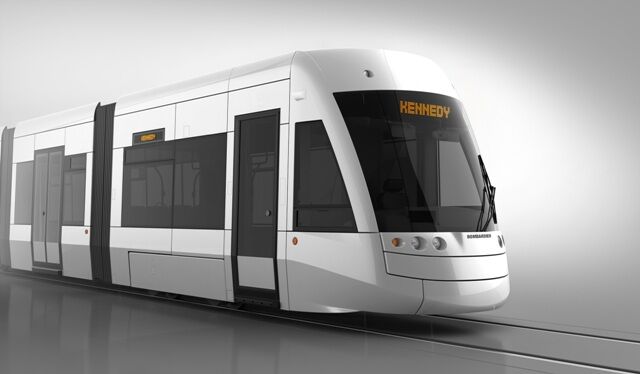 |
| The Eglinton-Crosstown LRT (Source: Metrolinx) |
This article is shared with Urban Toronto.
This morning, Metrolinx announced its decision to proceed with an alternative financing and procurement model for the new Eglinton Crosstown LRT. In other words, private consortia will compete for the right to build and operate the new line instead of the TTC. If the contract is well designed, this approach can transfer the risk of delays and cost overruns from the government to the private partner. The Canada Line in Vancouver is a good domestic example of this type of procurement, and its private consortium completed the project more-or-less on budget and in time for the 2010 Olympics.
The TTC’s response quoted in the Star verged on the bizarre, trying to cause anxiety that riders would be forced to pay separate fares to ride the new Eglinton line. This certainly need not be the case, as the Canada Line is fully integrated into the existing transit system with seamless connections. The TTC tried to claim that Eglinton Crosstown and the Canada Line are “a completely different scenario because the Canada Line is restricted to a single route with far fewer connections than the Eglinton line will have, and no zones.” It is difficult to understand what they meant by far fewer connections, since the Canada Line connects with the existing Skytrain and numerous bus routes. The presence of zone fares in Vancouver is also an irrelevant distraction. The TTC understandably isn’t enthusiastic about losing control of a major piece of transit infrastructure in the middle of its service area, but a well-designed AFP could prove to be a cost-effective option.
Eglinton Crosstown and the Canada Line are hardly “completely different” and there is absolutely no reason why Eglinton can’t and won’t be completely integrated into the TTC’s fare system. The main difference between the two lines is that the Canada Line cost $2 billion for 19.2 km of fully grade-separated rapid transit, while the Eglinton line is projected to cost three times as much (~$6 billion at last count) for 25 km (including rehabilitation of the existing Scarborough RT corridor) with far less capacity and a reliability-killing on-street section in the middle.
 |
| The Canada Line Bridge over the Fraser River (Source: Canada Line) |
With cost estimates already so high, there is little incentive for the private consortia to keep costs low. If the private bidders were to be able to reduce costs to even twice that of the Canada Line per kilometre, it would likely be possible to fully grade-separate the Eglinton Crosstown (perhaps with an elevated segment through western Scarborough) without increasing its current budget.
Transit-Oriented Development Failure: Brampton Edition
It is difficult to find a better example of
the failure to site major development around transit infrastructure than the
planned Osmington mall in Northwest Brampton. This vast project is intended to encompass
a regional mall of over 1 million square feet, 300,000 square feet of office
space, 2,000 residential units, and a 350-room hotel. 4,600 people will commute
there for work every day. It will be designed on “lifestyle centre” principles,
similar to the new Don Mills Centre, which are intended to create a suburban
experience that is more pedestrian-friendly than the traditional
mall in a sea of parking. Regional malls adjacent to TTC subway stations
generate thousands of transit riders per day. It’s hard to imagine anything
better suited to being located at a suburban transit hub.
Unfortunately, this immense new development
will be located just beyond reasonable walking distance of the Georgetown GO
corridor and the Mount Pleasant station. Instead, it will be built as suburban
malls have always been: at an arterial intersection next to the planned Brampton
North-South expressway, a bleak 1.2 km walk from the rail station. The planning
report pays lip service to “transit-oriented development,” but the Osmington
project will not be oriented to the rail corridor that should be the backbone
of transit in the region. Meanwhile, Mount Pleasant station will be surrounded
by quaint townhouses and strip mall retail that will generate at best a few
dozen riders a day. While townhouses may create the old-timey
village-around-a-station effect that feels like appropriate transit-oriented
development, a large shopping centre, even with a suburban design, generates
far more riders.
Of course the existing commuter-oriented,
peak-only GO rail service wouldn’t be terribly useful for a shopping
destination. But CityRail-style regional rail service would provide rapid
transit service and this development could be one of its major anchor
destinations.
Subscribe to:
Posts (Atom)